

 by MustafaMukhtar, MBA, ITIL
Consultant/Content Contributor, E-N Computers
20+ years of experience in IT management, project planning, enterprise systems and user support
A defense contractor recently called our office asking about CMMC consulting. The conversation went well until he asked how long compliance would take.
“Typically, 12 to 18 months,” our team explained.
“Oh. Well, another company quoted me 45 days, so I’m just going to go with them.”
He hung up before we could explain why that timeline is—let’s be diplomatic—optimistic.
Here’s the reality: you could technically become CMMC compliant in 45 days. You’d just have to accept all CUI by fax machine in a locked room and never actually do anything with it.
Congratulations. You’re compliant. You’re also out of business.
For years, the Cybersecurity Maturity Model Certification (CMMC) felt like a distant “someday” requirement. In 2026, that grace period is over. The Department of Defense (DoD) has moved from planning to enforcement, and for organizations in the Defense Industrial Base (DIB), CMMC compliance is now a prerequisite for doing business.
The market is full of “compliance in a box” solutions and vendors promising easy, done-for-you certification. Some of these tools are fully compliant—until you actually try to do something productive, like edit a document or collaborate with your team. Others rely on auditors who don’t ask hard questions.
That approach might get you a certificate. It won’t get you a security posture that survives contract performance or a DoD audit.
The real question is no longer whether you need CMMC, but how long it will take to get there—and get there in a way that doesn’t cripple your operations. The answer depends on your current security posture, how CUI flows through your organization, and whether you’re starting from scratch or building on existing controls.
Here’s a step-by-step guide on what’s involved in CMMC compliance, how long each step is likely to take and what you can do to make it move as quickly as possible – while still being able to run your business.
QUICK ANSWER:
How long does CMMC compliance take?
For most small-to-mid-sized defense contractors, CMMC compliance takes 12–18 months from initial scoping to certification.
- CMMC Level 1: 1–3 months (self-assessment)
- CMMC Level 2: 12–18 months (third-party assessment required)
- CMMC Level 3: 18+ months (government-led assessment)
Timelines vary based on how CUI is scoped, the current security posture, staff readiness, and budget. Organizations that wait until a contract is released to begin compliance are typically too late—CMMC must be in place before bidding.
“You could become compliant by just saying, ‘I’m only going to accept CUI by fax machine in a locked room,’ and then you’re compliant,” Ian MacRae, president of E-N Computers and CMMC Registered Practitioner
Why can’t most companies reach CMMC compliance faster?
Technically, timelines that are faster than 12 to 18 months are possible.
Organizations with a dedicated budget, small user counts, and a full migration into a pre-configured compliant environment—such as a GCC High enclave—can reach readiness in as little as six months.
For most organizations, however, budget is the constraint. Hardware upgrades, licensing changes, consulting support, and staff time are often spread across a fiscal year, extending the overall timeline.
The real cost of CMMC Level 2 compliance
Level 2 compliance is not a small upgrade. Thus budget constraints are the most common reason CMMC timelines stretch beyond 12 months. CMMC often requires organizations to double their existing IT and security budget.
Typical cost ranges for CMMC Level 2:
- Small organizations (10–25 users): $75,000–$150,000
- Mid-sized organizations (25–100 users): $150,000–$300,000
- Larger or complex environments: $300,000+
These costs reflect three primary drivers: consulting, tools, and time.
Most organizations require a lot more hands-on consulting during CMMC preparation. Instead of quarterly check-ins, compliance efforts often demand monthly or even weekly working sessions to stay on track. At typical consulting rates, this alone can add thousands per month.
The largest hidden cost is internal time. Managing compliance internally means learning complex tools, mapping them to NIST SP 800-171 controls, maintaining documentation, and collecting evidence. Organizations that lack dedicated security staff often underestimate this effort.
Finally, organizations must budget for the C3PAO assessment itself. Third-party assessments are typically conducted by multiple certified assessors over several days, with costs commonly ranging from $30,000 to $50,000 per location, increasing for multi-site environments.
Organizations that spread these costs across a fiscal year often extend their compliance timeline to 18 months by necessity, not choice.
Who should start now (and who can wait)
Start now
You should already be preparing for CMMC if you fall into any of the following groups:
- Prime contractors bidding on DoD work
- Subcontractors that handle or store CUI, even if your prime hasn’t asked yet. Flow-down requirements mean primes are increasingly requiring CMMC certification before contract award, and retroactive compliance is nearly impossible on active timelines
- Organizations unsure whether they touch CUI. If CUI may be involved, scoping should start now.
By 2026, CMMC requirements are appearing directly in the Requirements sections of DoD solicitations. If you wait until an RFP is released to begin a 12-month compliance journey, the opportunity is already gone. Compliance must be in place before the bid.
Who can wait (for now)
A small group of organizations may be able to delay full CMMC preparation:
- Companies that do not handle CUI and only support DoD work indirectly
- Vendors providing commercial off-the-shelf (COTS) products with no access to controlled data
- Organizations whose DoD exposure is theoretical or long-term, with no near-term bidding plans
Even in these cases, basic scoping is still recommended. Waiting only makes sense if CUI is clearly out of scope. Typical CMMC deadlines are:
- CMMC Level 1: 1–3 months (self-assessment)
- CMMC Level 2: 12–18 months (third-party certification)
- CMMC Level 3: 18+ months (government-led assessment)
CMMC Level 3 applies to a small group of contractors supporting high-priority or mission-critical DoD programs and facing advanced cyber threats. Assessments are conducted directly by the U.S. government.
Most organizations will never need Level 3. If it applied to you, the DoD would already be communicating with that requirement clearly. For the vast majority of readers, Level 2 is the highest level to plan for.
The three phases of CMMC Level 2 compliance
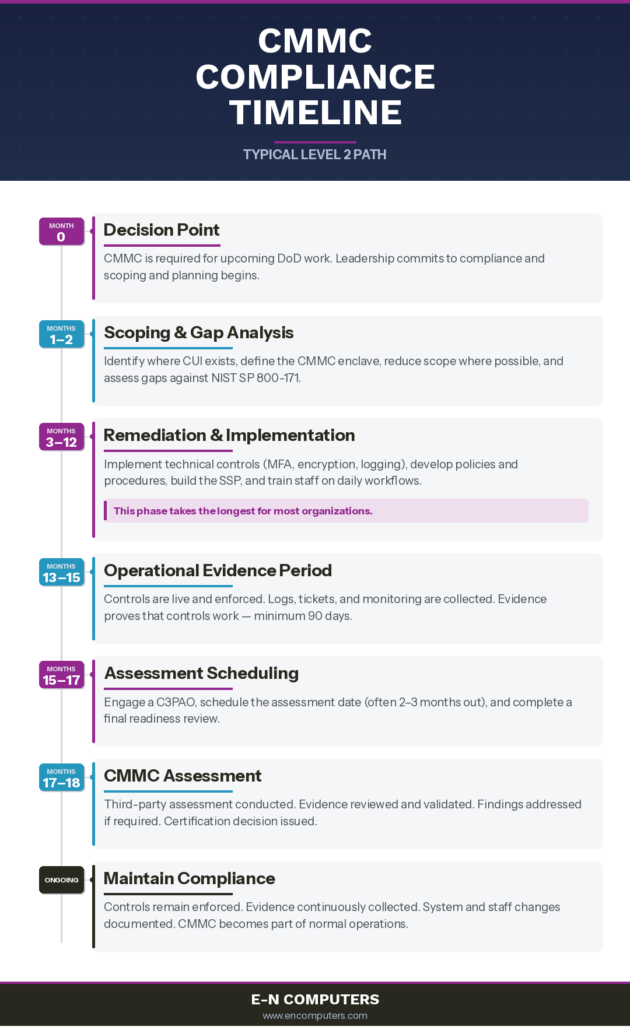
1. Scoping and gap analysis (months 1–2)
The most common mistake organizations make is focusing on technology too soon. Start with data, not tools.
You must identify where Controlled Unclassified Information (CUI) exists and how it moves through your organization. That includes servers, cloud systems, email, endpoints, backups, and even physical locations like printers or shared workspaces.
The goal: Define your CMMC “enclave,” the clearly defined boundary of systems, networks, and users that handle CUI and must meet compliance requirements.
The reality: Most organizations discover their CUI is far more scattered than expected. Cleaning up data flows, consolidating systems, and reducing scope often takes weeks before remediation can even begin.
How CUI scope impacts cost and timeline
CUI scope is one of the biggest drivers of both timeline and cost. When CUI is spread across multiple systems, departments, or user accounts, every one of those systems must meet all applicable controls. When CUI is contained within a clearly defined enclave, remediation becomes faster, simpler, and easier to defend during an assessment. Reducing scope early can shave months off the process.
2. The remediation marathon (months 3–12)
This is where the real work happens. For CMMC Level 2, organizations must meet all 110 controls in NIST SP 800-171. Think of it as an operational shift, not a software purchase. Here’s some of what needs to happen:
Technical remediation
Implementing FIPS-validated encryption
Enforcing Multi-Factor Authentication (MFA)
Centralizing logging and monitoring
Secure configuration and access control
Documentation and policy development
You must create and maintain a System Security Plan (SSP) that explains, in detail, how each control is met. This document becomes the foundation of your assessment.
The culture shift
Employees must adapt to tighter access controls, new file-sharing rules, and more structured workflows. This adjustment period is often the biggest bottleneck, not the technology itself.
What slows companies down
Most delays are not caused by security tools. Common time killers include:
- CUI living in shared drives, inboxes, or personal cloud storage
- Policies that exist but are not followed consistently
- Limited IT staff unable to collect and maintain evidence
- Leadership underestimating how much daily behavior must change
CMMC readiness vs. CMMC certification
Many organizations believe they are “compliant” because controls are implemented. Readiness and certification aren’t the same thing. Readiness means controls exist and policies are written. Certification means controls are operating, monitored, and provable over time. Assessors are not there to see what could work. They are there to see what has been working.
3. Evidence period and assessment (months 13–18)
CMMC assessments are evidence-based. You cannot “turn it on” the week before the audit.
The 90-day expectation:
Most C3PAOs expect at least three months of logs, access records, tickets, and monitoring data that show controls are consistently enforced.
Assessment scheduling:
Due to high demand, scheduling a Certified Third-Party Assessment Organization (C3PAO) can take 2–3 months. The assessment itself typically spans one to two weeks and functions as an open-book review of your security posture, documentation, and operational practices.
What a C3PAO will ask for
Assessments are structured and predictable. You should expect requests for:
- Your System Security Plan (SSP)
- Policies and procedures mapped to controls
- Evidence of enforcement (logs, alerts, tickets)
- Proof controls were active prior to the assessment
What happens if you don’t pass your CMMC assessment?
If an assessment identifies gaps, you’ll receive a detailed findings report outlining the deficiencies.
In limited cases, minor gaps may be documented in a Plan of Action and Milestones (POA&M), allowing remediation to continue—but certification is not granted until required controls are fully met, in accordance with DoD rules and contract requirements.
Significant control failures typically require remediation followed by a reassessment, which can add three to six months to the timeline and may require additional assessment fees.
This is why the evidence period matters. Assessors expect proof that controls were operating consistently before the assessment—not enabled temporarily for audit purposes.
Next steps
CMMC is not a one-time certification you earn and forget. After passing your assessment:
- Controls must remain enforced
- Evidence must continue to be collected
- System changes and staff turnover must be documented
- Annual audits or reassessments may be required depending on your contracts
- CMMC becomes part of daily operations, not a project with an end date
Most CMMC consultants hand you a gap assessment and a remediation checklist, then leave you to figure out the rest. We don’t work that way. E-N Computers is a managed IT provider and a CMMC consultant — which means we can scope your environment, implement the technical controls, build your documentation, and keep you compliant through your three-year certification cycle. No handoff to a separate IT team. No starting over with a new vendor when it’s time to act on the recommendations.
We work best with defense contractors under 200 employees — manufacturers, engineers, and design firms where compliance intersects with operational complexity. If you’re too small for an enterprise consultant like Summit7 but too regulated to wing it, that’s exactly the gap we fill.
We’ve been working with government contractors in Virginia and the DC metro area for nearly 30 years, and our clients work directly with owner Ian MacRae and a local team — not a rotating cast of account managers. If you want to see what this looks like in practice, we’ve walked a Virginia contractor through the full process from scoping to near-certification without breaking their budget.
CMMC RESOURCES
If you need CMMC managed IT services
- Virginia CMMC Managed IT Services
- Best CMMC managed IT services providers in the DMV
- Best Virginia CMMC managed IT services providers
If you need to better understand CMMC requirements:
- The Ultimate Guide to CMMC
- The Ultimate Guide to DFARS and NIST 800-171 (in plain English)
- What is FCI and should I worry about it?
- What is CUI and should I worry about it?
- CMMC compliance deadlines: Key dates and what they mean
If you’re looking for CMMC tools and training:
- We found the best GRC tool for CMMC
- What is Microsoft GCC High and do I need it?
- Best CMMC training resources
- CMMC Level 1 guide as audio book
- CMMC Level 2 guide as audio book
- CUI enclaves in CMMC compliance: Are they right for your business?
If you’re looking for a CMMC consultant or Registered Practitioner Organization:
- Best CMMC consultants
- Best CMMC RPOs near Washington, DC
- Best Virginia Registered Practitioner Organizations
- Case Study: Virginia Government Contractor Nears CMMC Compliance
- CMMC Gap Analysis
If you’re looking for a CMMC assessor:
If you’re looking for information about CMMC that is targeted toward smaller businesses:
Complimentary review with an experienced engineer
Are you ready for CMMC?

Get a free strategic consultation to start or streamline your journey toward CMMC compliance.