 by Scott Jack
Content Contributor, E-N Computers
15 years in IT operations and knowledge management
Updated December 8, 2025
Your top competitor is growing but you can’t even get your teams to agree on what software to use. Everyone is using different systems, data is siloed, and you’re either trying to cobble everything together or block the use of unapproved software. This disconnect is a frustrating and expensive way to run a business.
This internal friction is because your business and IT strategies are not aligned. In other words, business decisions are being made without thinking through how technology will support them, and IT decisions get made without fully understanding business needs. The result is bad blood between departments, decreased morale, and increased burnout. All the energy that could be spent on growth gets spent on barely keeping things running.
It doesn’t have to be that way. With a deliberate planning process, you can align your business and IT strategies so that they work together. Instead of struggling against internal friction, you can build a powerful, efficient engine for growth.
A strategic managed service provider (MSP) can provide exactly this kind of structured process and expert guidance. We’ll explore the tangible benefits of true Business-IT alignment and outline how to achieve it for your organization.
QUICK ANSWER:
How does business IT alignment benefit SMBs?
Business IT alignment synchronizes business and IT functions, eliminating friction and redirecting that energy into efficiency and growth. Instead of departments fighting over tools or IT blocking business needs, you create a unified approach where technology decisions directly support business goals.
In 2026, this means having a clear AI adoption strategy, implementing modern cybersecurity like Zero Trust, and enabling secure hybrid work—all planned strategically rather than reactively. The result is competitive advantage, better employee and customer experiences, and protection against costly cyber incidents.
Table of Contents
The real cost of misalignment: A tale of two companies

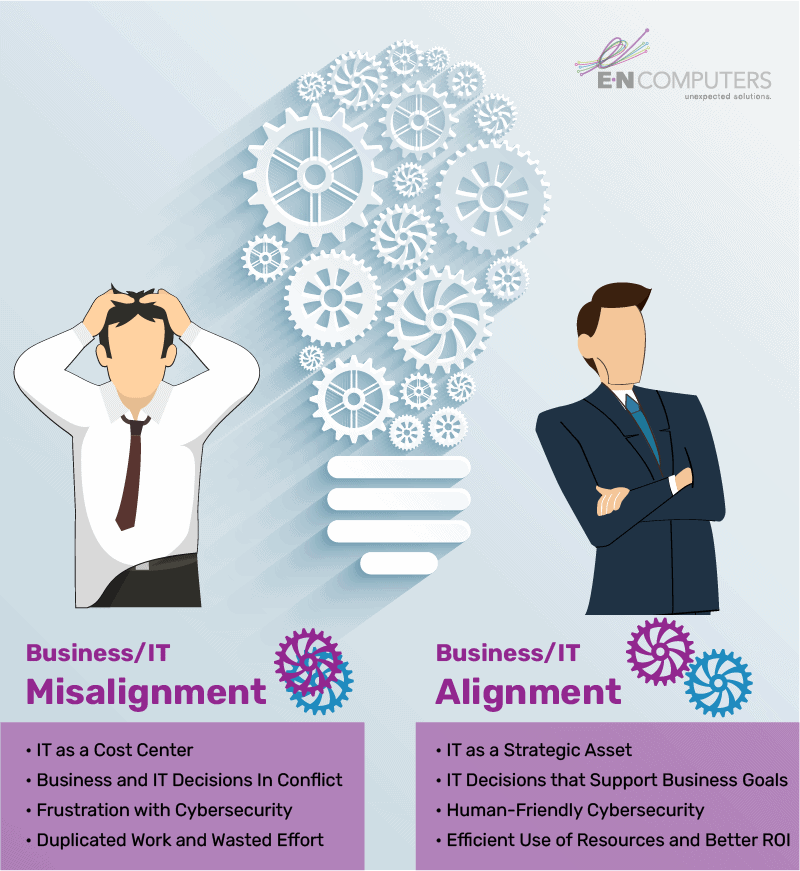
Consider an example of two fictional companies. One has completely misaligned business and IT. The other collaborates on an aligned business IT strategy.
Company A — The misaligned mess
Company A is misaligned due to lack of communication.
- Scenario 1: The marketing team buys an AI analytics tool without consulting IT. The tool doesn’t integrate with the company’s existing tooling, violates data protection standards, and even duplicates features of other tools the company already pays for. Money and effort are wasted, marketing is frustrated, and IT has to clean up the mess.
- Scenario 2: In response to increased cybersecurity risks, IT implements a new policy that blocks offsite access to a critical sales tool without consulting the sales team. The sales process slows down, staff implement insecure workarounds like saving files to personal devices, and quarterly targets are missed.
In both cases, a lack of communication and collaboration led to wasted money, lost productivity, and increased risk.
Company B — The aligned engine
Company B uses fractional CTO and vCIO services from their MSP to make decisions.
- The problem: The sales process is slow due to outdated tools and processes, and we need to improve our security posture to win key contracts.
- The process:Key members of the MSP, sales, and executive teams sit down to discuss workflow and needs like speed, mobility, and ease of use. Specific security issues are identified.
- The result: Instead of a turf war, there’s collaboration. The MSP identifies secure tools that will meet the needs of sales. The solution is piloted and rolled out with proper training. The sales team is more effective and the company’s improved security posture sets them up to win contracts.
Strategic alignment is about making sure that technology decisions support business goals securely and efficiently. It eliminates friction so that your business engine runs smoothly.
What is business IT alignment in 2026?
Business IT alignment comes down to three core concepts: shared vision, shared language, and technology as an accelerator.
Shared vision
We integrate technology into the business. We don’t make a business decision and then figure out how IT is going to make it work, nor do we decide on an IT policy and then make business processes fit around it. Collaboration between IT and key decision makers provides momentum for reaching business goals, improving financial performance, and gaining a competitive advantage.
Shared language
At times, business and IT teams struggle to communicate. When this happens, business people grumble that IT pushes new technology on them without considering existing processes, while IT people grumble because no one consulted them and they expect their efforts to go unused or underutilized based on past experience. A fractional CTO can be useful in these situations because their role is about translating between business and IT and providing strategic guidance that meets both needs.
Technology as an accelerator
You might find yourself looking at technology expenses and thinking “look at how much all of this is costing me!” This temptation grows stronger when you tack tech onto your business instead of integrating it into your operations. Organizations must view technology as an essential part of their mission and goals. Leaders should balance business revenue streams when making technology investment decisions and plan for acceptable returns on investment. A fractional CTO can help here by evaluating the costs of technology risks like downtime and security breaches, while also helping prioritize technology spending for the best return.
Business IT themes in 2026
Business IT alignment comes down to three core concepts: shared vision, shared language, and technology as an accelerator.
AI strategy
We’re not all-in on AI, but we also realize that in 2026, you must have an AI policy. Even if you do not officially provide AI tools, someone in your company is using an AI for their work. And if they’re not using a company tool, that means they’re probably using a personal account. Here’s the catch: free AI plans vacuum up any data that you input “for training purposes”.
That means that you need a policy, tooling, and a plan. When you have alignment on what AI tools are available and how they can be used, you can protect your data, control costs, and more effectively integrate AI into mature business processes. Instead of haphazardly throwing AI at a problem, you’ll have a real competitive advantage.
Cybersecurity
Small businesses continue to be popular targets for cyber attacks, and those attacks are becoming more sophisticated. AI-powered attacks are enabling highly convincing phishing campaigns, and ransomware-as-a-service is more accessible than ever. Cyber insurance providers and major clients are demanding proof of modern security controls, making cybersecurity a prerequisite for doing business. The traditional, reactive approach of simply having a firewall and antivirus is not enough to protect you or satisfy compliance requirements.
Strategic alignment reframes cybersecurity as a proactive piece of business continuity. This means implementing modern frameworks like Zero Trust, which continuously verifies every user and device, rather than assuming insiders are safe. It involves using unified security tools like Microsoft Defender XDR to automatically detect and disrupt threats in seconds, not hours. This hardens your business against attack, reduces insurance premiums, and gives you the documented security posture needed to win and retain high-value contracts.
Secure hybrid and remote work
Organizations can leverage technology to create secure hybrid and remote work environments and gain a competitive advantage in 2026. While some companies make waves with strict return-to-office (RTO) policies, you can gain access to a broader talent pool by offering hybrid and remote work arrangements.
To make this happen, you’ll need to plan for secure remote access (with technologies like zero-trust network access, endpoint detection and response, and multifactor authentication), collaboration tools, and optimized cloud infrastructure.
Three key benefits of business IT alignment

When business and IT work together strategically, the benefits compound quickly. You don’t just avoid friction and waste—you actively gain competitive advantages that drive growth. Here are the core benefits that matter most in 2026.
Innovation & Competitive Advantage: When IT and business strategies align, you can harness emerging technologies like AI to outpace competitors. Instead of marketing teams secretly using ChatGPT with company data or sales teams struggling with outdated tools, you’ll have a deliberate AI strategy that protects data while boosting productivity. You’ll evaluate new technologies for business impact, adopting tools that move the needle. While competitors get stuck in departmental turf wars, you’re testing, iterating, and pulling ahead.
Enhanced Customer & Employee Experience: Strategic alignment means technology actively supports how people work instead of hindering them. Your hybrid workforce gets secure remote access to needed tools without clunky VPNs or security theater that slows everything down. Employees can focus on serving customers instead of wrestling with disconnected systems. The result? Better employee retention, faster customer response times, and a reputation for being easy to work with.
Financial Optimization & Cyber Resilience: Strategic technology planning eliminates expensive chaos from ad-hoc decisions. You stop paying for duplicate tools that different departments bought without coordination. You build a technology roadmap with predictable budgeting instead of constant emergency spending. More importantly, you avoid catastrophic cyber incident costs. Modern security frameworks like Zero Trust and tools like Microsoft Defender XDR become standard practice, not afterthoughts. This proactive approach reduces cyber insurance premiums, satisfies client security requirements, and protects you from six- and seven-figure ransomware and data breach costs.
Business-IT alignment transforms your organization from the inside out. Instead of departments pulling in different directions, you create a unified team focused on external competition. Your employees understand how their work connects to business goals and have the right tools to execute. But how can a small business achieve this integration without an expensive C-suite IT executive?
First steps you can take without an MSP
Ready to begin aligning your business and IT strategies but not sure where to start? Here are practical steps you can take internally to lay the groundwork for better alignment. You can use our IT Maturity assessment as a guide.
Map your current reality. Start with an honest assessment of what you have. Document all the software tools each department uses, including shadow IT like personal ChatGPT accounts or unapproved apps. Create a simple spreadsheet listing every subscription, who uses it, and what it costs. You’ll likely discover overlapping tools and security gaps you didn’t know existed.
Bring key players to the table. Schedule a cross-departmental meeting with your department heads and whoever handles IT decisions. Don’t make this about finger-pointing—focus on understanding each team’s biggest technology pain points and business priorities for the next 12 months. You’re looking for patterns and opportunities where technology could eliminate friction.
Establish basic AI and security policies. Even if you don’t have formal IT leadership, you can create simple guidelines. Draft a one-page AI policy that specifies which tools are approved for company data (even if it’s “none until further notice”). Set basic security requirements like requiring multi-factor authentication on all business accounts and prohibiting the use of personal devices for sensitive company data.
Create a quarterly tech review process. Schedule recurring meetings where business leaders discuss upcoming projects and IT needs. This doesn’t have to be complex—just make sure technology decisions get discussed before departments make purchases or commitments.
Start documenting your technology roadmap. Even a simple document outlining known technology needs for the next 6-12 months helps prevent reactive spending. Include upcoming software renewals, hardware refresh needs, and any business initiatives that will require technology support.
These steps won’t solve alignment overnight, but they’ll help you move from chaotic, reactive technology management to more intentional planning. More importantly, this groundwork makes it much easier to work with an MSP or fractional CTO when you’re ready to take the next step toward full strategic alignment.
Realistically, a small business can struggle even with these initial steps. This groundwork, though, makes it easier to work with an MSP or fractional CTO when you’re ready to take the next step toward full strategic alignment.
How small businesses achieve alignment
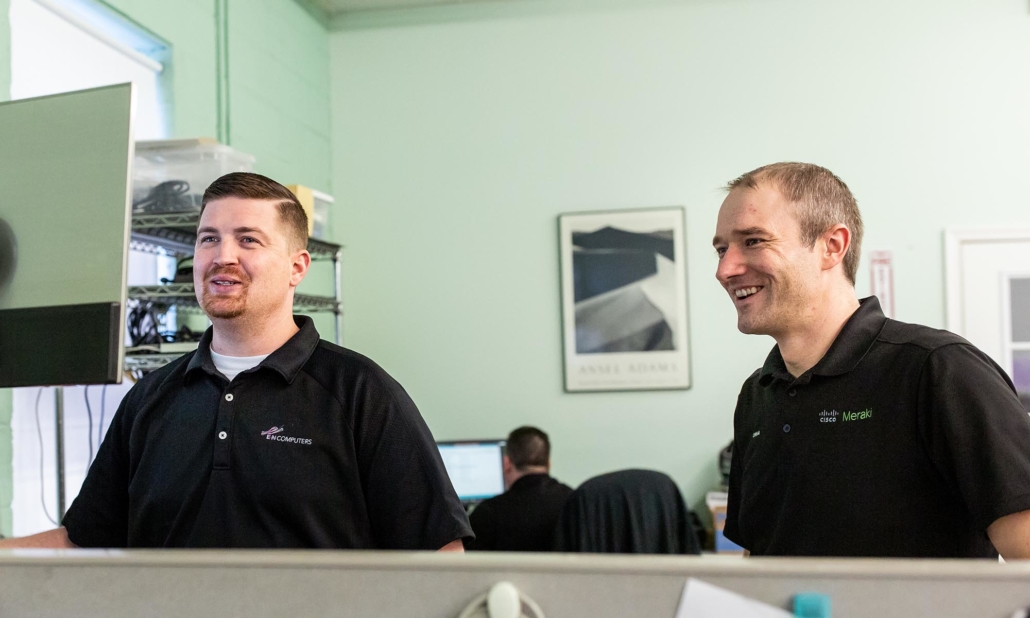
Successful business-IT alignment requires a properly staffed IT department. One or two in-house IT professionals will struggle to handle strategy, day-to-day support, and project management simultaneously. Beyond someone who can discuss strategy in both business and IT terms, you need engineers, technicians, and people to handle various administrative functions. How can you assemble all that firepower without breaking the bank?
A managed service provider with a good strategic planning process will provide you with all the IT resources you need to be successful. For example, E-N Computers includes strategic account management and virtual CIO (vCIO) services in all of our managed IT service plans. By means of regular updates, monthly reviews, and annual strategy meetings, we make sure that your information systems are aligned with your business goals and performing optimally. We also work with you to build a technology roadmap and budget that addresses the critical 2026 themes—developing a safe AI adoption strategy, implementing modern cybersecurity frameworks like Zero Trust, and securing your hybrid workforce with proper remote access tools. This roadmap helps you visualize and prepare for future expenses like hardware upgrades, software licenses and subscriptions, and project work.
Meanwhile, our administrative staff provides inventory and license management, project management, and watches for trends in your support requests that may indicate larger issues that need to be addressed. Skilled technicians provide day-to-day support through our help desk and on-site visits, with the backing of experienced engineers for more complex issues.
We have helped dozens of clients to keep technology aligned with their business goals. If you are ready to take a more strategic approach to business and IT, to integrate technology in a way that gives you a competitive edge, contact us today. We will be happy to talk with you about ways to improve your business-IT strategic alignment.
Next Steps: Learn more about managed IT services
Don’t let misalignment be the wrench in your growth engine. Start on the path of strategic business IT alignment today to turn technology into a powerful tool that helps your team do their best work.
If you’d like to learn more, we’ve selected a few articles from our learning center.
- Should I outsource my IT department? covers what a properly staffed IT department looks like, and why MSPs are a strong alternative for small businesses. It includes an in-house vs. outsourced IT calculator.
- What is included in managed IT services? explains what you get with our fully managed IT plans. When you see how all the pieces fit together, you can be confident that everything IT is cared for and you can focus on your organization’s mission.
Where are your biggest IT gaps? Take our free IT Maturity Self-Assessment to find out. In just a few minutes, you’ll see exactly where you stand on strategy, security, and operations—plus get specific recommendations and a free consultation to turn those insights into action.
Not sure if you need managed IT services?
Take the IT Maturity Self-Assessment

In a few minutes, get actionable insights on your IT strategy, plus a free strategic consultation.